
Imagine a classroom where a student is not simply reading about how machines work but is actually building one. They experiment with different components, writes instructions for a robot, observes what happens and tries again when something does not work as expected. What begins as a science lesson soon becomes an exercise in creativity, problem-solving, patience and independent thinking.
This is the value of STEM-based education. It moves learning beyond textbooks and encourages students to explore concepts through practical experiences. STEM, which stands for Science, Technology, Engineering and Mathematics, brings these interconnected disciplines together to help students understand how the world works and how they can contribute to shaping it.
For young girls, exposure to STEM is particularly valuable. It gives them opportunities to explore subjects that are increasingly important in the modern world, challenge conventional perceptions about technical fields and recognise their own ability to innovate.
At Heritage Girls School, Udaipur, STEM learning is supported through academic programmes, well-equipped laboratories, coding and robotics opportunities, and dedicated student clubs. By encouraging curiosity and practical exploration, the school aims to help girls become confident learners who are willing to question, experiment and discover.
1. Encouraging Curiosity Through Practical Learning
Children are naturally curious. They want to understand why things happen, how everyday objects work and what might happen if something is done differently. STEM education uses this curiosity as a starting point for meaningful learning.
Instead of approaching science and mathematics only as subjects to be studied, STEM-based learning encourages students to investigate concepts through observation, experimentation and application.
For example, a lesson about electricity becomes more engaging when students can observe how a circuit works. Learning about mathematical measurements becomes more meaningful when they use calculations to design or construct something. Similarly, understanding scientific principles through experiments helps students connect classroom concepts with real-world situations.
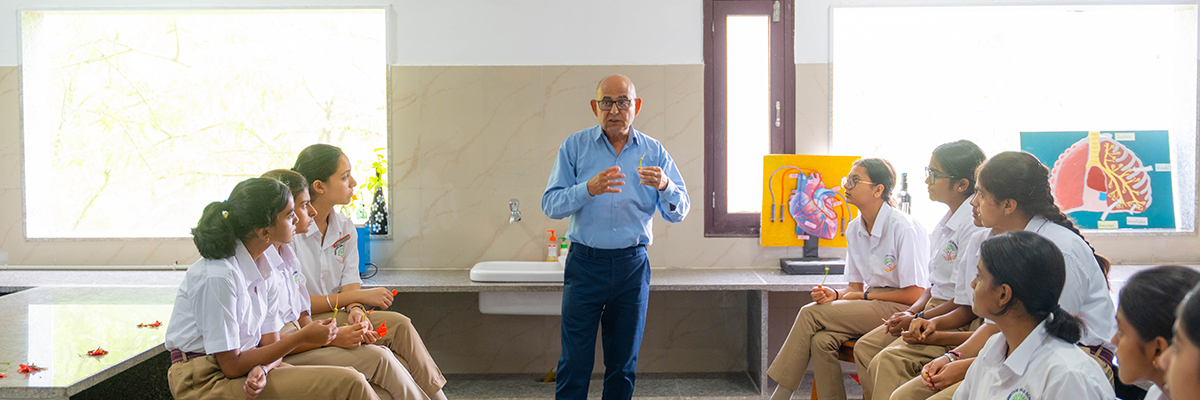
At Heritage Girls School, well-equipped laboratories provide opportunities for students to explore subjects through experimentation and observation. The school’s learning environment also encourages project work, scientific models and interactive activities.
The Science Club, Photon further supports this approach through interactive workshops, guest lectures, seminars, hands-on experiments and science exhibitions.
These experiences encourage students to ask questions rather than simply accept information. They begin to understand that learning is not always about finding an immediate answer. Sometimes, it is about exploring possibilities, making observations and discovering something new along the way.
2. Developing Creativity Through Innovation and Experimentation
Creativity is often associated with art, music and literature. However, it is equally important in science, technology, engineering and mathematics.
Every innovation begins with an idea. Finding a way to improve an existing process, designing a useful device or developing a solution to a practical problem requires imagination and the ability to look at situations differently.
STEM education gives students opportunities to practise this kind of creative thinking. When they are presented with a challenge, they are encouraged to explore different approaches instead of relying on a single solution.
Consider a student working on a robotics project. She may begin with an idea of what she wants the robot to accomplish. However, turning that idea into something functional requires her to think about its design, components, instructions and movement. She may need to modify her original approach several times before achieving the desired result.
Each stage involves creativity, experimentation and decision-making.
At Heritage Girls School, the AI and Robotics Club provides students with opportunities to work with components such as 3D printers, Arduino boards, sensors, LEDs and batteries. Under the guidance of trained faculty, students can build and experiment with automated devices.
Such activities allow girls to move from imagining a solution to exploring how it can be created. They learn that creativity is not limited to coming up with ideas; it also involves finding practical ways to bring those ideas to life.
3. Strengthening Critical Thinking and Problem-Solving Skills
In a world where information is readily available, knowing how to think critically is just as important as knowing facts. Students need to be able to analyse information, identify problems, evaluate possibilities and make informed decisions.
STEM education naturally encourages these abilities because scientific and technical challenges rarely have one straightforward answer.
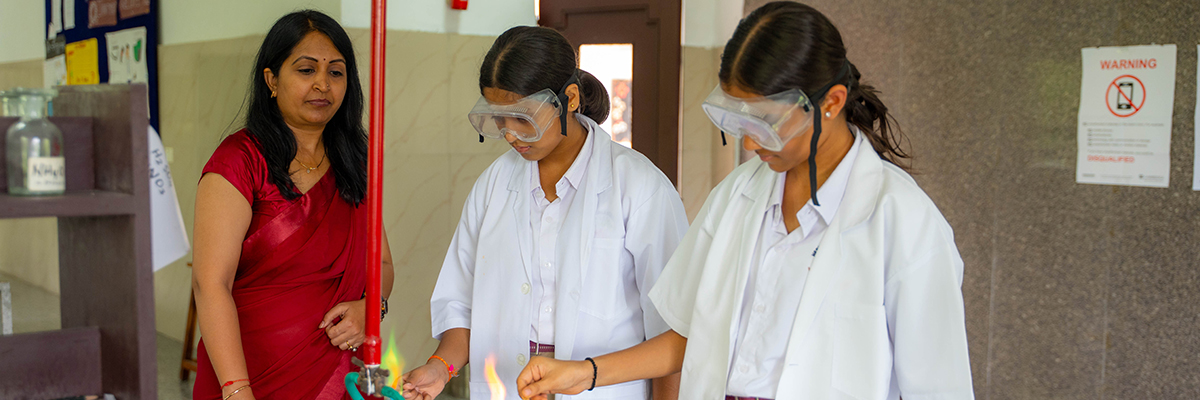
When conducting an experiment, for instance, students must observe what happens, compare results and consider why an outcome may differ from what they expected. In coding, they need to identify errors in their instructions and work towards correcting them. In engineering activities, they may have to evaluate different designs before deciding which one is most effective.
These processes teach students to approach challenges systematically.
At Heritage Girls School, the emphasis on application-based learning and independent thinking complements this approach. Through its science and technology facilities, students have opportunities to engage with concepts beyond theoretical explanations.
The AI and Robotics Club also encourages logical reasoning through practical projects. Building an automated device involves understanding how different components work together and identifying what needs to change when the device does not function as intended.
Over time, students become more comfortable analysing problems rather than feeling overwhelmed by them. They begin to understand that mistakes are not necessarily failures. They are opportunities to identify gaps in understanding and improve an approach.
This ability to think independently is useful far beyond STEM subjects. It can support decision-making in academics, personal life and future professional environments.
4. Building Confidence by Making Girls Active Participants in Technology

Confidence develops when students are given opportunities to try something new, participate actively and see their efforts translate into results.
For girls, early and consistent exposure to science and technology can help create a sense of familiarity with these fields. Rather than viewing coding, robotics or engineering as unfamiliar or intimidating subjects, they begin to see them as areas they can explore and excel in.
A student who successfully writes her first programme, builds a working model or solves a challenging mathematical problem gains more than subject knowledge. She also gains confidence in her ability to understand complex ideas and work towards solutions.
Heritage Girls School’s AI and Robotics Lab provides a dedicated space for this kind of exploration. The school has also introduced students to emerging technologies through hands-on sessions.
As girls become more comfortable experimenting with new tools, they are also more likely to participate in discussions, share ideas and take initiative during collaborative activities.
The confidence developed through these experiences can influence how they approach other academic and personal challenges as well.
5. Introducing Girls to Artificial Intelligence and Emerging Technologies
Technology is constantly evolving, and artificial intelligence is becoming an increasingly important part of everyday life. From digital assistants and recommendation systems to applications in healthcare, education and research, AI is influencing how people interact with the world.
Introducing students to these developments helps them become more informed and responsible users of technology.
AI education can also encourage students to think about how machines process information, how algorithms identify patterns and why human judgement remains important when using technology.
At Heritage Girls School, the introduction of the AI and Robotics Lab provides students with opportunities to explore emerging technologies through practical engagement. The school has also organised workshops introducing participants to the fundamentals and future possibilities of artificial intelligence and robotics.
Such exposure helps students understand that technology is not simply something to consume. It is something they can study, question and potentially contribute to developing.
Equally important is learning to approach technology responsibly. Students need to understand that technological developments also raise questions about privacy, accuracy, fairness and the impact of automated decisions.
By combining technical exploration with critical thinking, schools can help prepare girls to engage thoughtfully with an increasingly technology-driven world.
6. Learning Collaboration and Communication Through STEM Projects
Although STEM activities often involve individual experimentation, many projects require students to work together. Designing a model, completing a robotics challenge or presenting a scientific project can involve several people contributing different ideas and skills.
This makes STEM education an opportunity to develop communication, collaboration and teamwork.
When students work together, they learn to explain their reasoning, listen to alternative suggestions and divide responsibilities. They may not always agree on the best approach, but discussing different possibilities helps them consider perspectives they might not have explored independently.
At Heritage Girls School, activities through the Science Club – Photon and AI and Robotics Club provide opportunities for students to engage with others who share similar interests.
Workshops, seminars and science exhibitions also create opportunities for students to discuss their work and present what they have learnt.
These experiences are important because technical knowledge alone is not enough to solve every challenge. Being able to communicate ideas clearly, work with different people and explain how a solution functions are equally valuable skills.
By participating in collaborative STEM activities, girls can develop the confidence to contribute their ideas while recognising the value of collective effort.
7. Preparing Girls for Future Academic and Career Opportunities
The knowledge and skills developed through STEM education can open doors to a wide range of academic and professional opportunities.
Traditional STEM-related career paths include engineering, medicine, scientific research, mathematics and computer science. However, the influence of these disciplines now extends into fields such as environmental studies, finance, design, business, healthcare and artificial intelligence.
Students who develop an interest in STEM during their school years can gradually explore these possibilities and make more informed decisions about their future education.
Heritage Girls School offers students the choice of CBSE and Cambridge International Education pathways, with Science available as a Higher Secondary stream. Its academic approach emphasises critical thinking, creativity and the application of knowledge.
The school’s coding, robotics and science-related activities complement this academic foundation by allowing students to explore how concepts can be applied in practical situations.
More importantly, STEM education develops transferable skills. Analytical thinking, adaptability, logical reasoning, creativity and problem-solving are useful across a variety of careers, including those that may not traditionally be associated with science or technology.
The objective is not to encourage every student to pursue a technical career. It is to ensure that every girl has the opportunity to explore these disciplines, understand their possibilities and make choices based on her interests and abilities.
Conclusion
A student’s journey through STEM education is about much more than learning scientific formulas, understanding mathematical concepts or writing lines of code. It is about developing the confidence to ask questions, the creativity to explore possibilities and the determination to find solutions when challenges arise.
For girls, these experiences can also help broaden their understanding of what they are capable of achieving. When they are encouraged to experiment, participate and take ownership of their learning, they begin to see themselves as creators and problem-solvers.
At Heritage Girls School, the combination of academic learning, science laboratories, the Science Club Photon and the AI and Robotics Club creates opportunities for students to explore these possibilities. The school’s approach reflects its larger belief that Every Girl is a Leader.
Because the future does not simply belong to those who understand technology. It belongs to those who can question it, improve it and use it creatively. And with the right learning environment, every girl can begin developing the skills and confidence to be part of that future.