

Imagine a classroom where students are no longer just reading about technology but actively learning how to create it. A group of students is programming a robot to follow a specific path, while another is experimenting with an artificial intelligence tool to understand how it recognises patterns. Some are testing their designs, others are correcting errors, and everyone is learning through the process of discovery.
This is increasingly becoming a part of modern education. Artificial Intelligence (AI) and robotics are changing how students interact with technology, approach problems and understand the world around them. What was once considered an advanced subject reserved for university students and technical professionals is gradually finding its place in school classrooms.
As technology continues to influence almost every industry, introducing students to AI and robotics at an early age can help them develop the knowledge and skills needed to navigate an evolving world. More importantly, these subjects encourage creativity, logical reasoning, collaboration and independent thinking.
The future of education is not simply about teaching students how to use technology. It is about helping them understand how it works, question its applications and develop the confidence to create solutions of their own.
1. Making Learning More Interactive and Practical
Traditional classroom learning often relies on textbooks, explanations and written exercises. While these remain important, students also benefit from opportunities to apply what they learn in practical situations.
AI and robotics introduce a more interactive approach to education. Instead of only studying theoretical concepts, students can experiment with technology, build models, write basic programmes and observe how different systems respond to their instructions.
For example, when learning about robotics, students may be introduced to sensors, motors and programming instructions. They can then use this knowledge to build a simple robot that responds to its surroundings. Similarly, introductory AI activities can demonstrate how computers recognise images, identify patterns or process information.
These experiences help students connect abstract concepts with real-world applications. They also make lessons more engaging by allowing students to participate actively in the learning process.
When students can see the results of their ideas and experiments, learning becomes more meaningful and easier to relate to everyday life.
2. Developing Critical Thinking and Problem-Solving Skills

One of the most important benefits of AI and robotics education is the opportunity to develop critical thinking.
Building a robot or writing a computer programme involves much more than following instructions. Students must understand the problem, break it into smaller steps, identify possible solutions and evaluate whether their approach is working.
Consider a student programming a robot to navigate an obstacle course. If the robot takes the wrong turn or fails to detect an object, the student must investigate what went wrong. Was the sensor positioned incorrectly? Were the instructions incomplete? Does the programme need to be adjusted?
Finding the answer requires observation, logical reasoning and patience.
Similarly, AI-based activities encourage students to examine how systems process information and generate results. They can explore why an AI tool may produce an inaccurate answer or how the quality of the information provided affects its output.
These experiences teach students not to accept every result at face value. Instead, they learn to question, analyse and make decisions based on evidence.
Such skills are valuable across all areas of education. Whether a student is solving a mathematical problem, conducting a science experiment or evaluating information for a classroom project, the ability to think critically helps her approach challenges more effectively.
3. Encouraging Creativity and Innovation
Technology and creativity are often viewed as separate areas of learning. However, innovation requires both.
AI and robotics education gives students opportunities to turn imaginative ideas into practical projects. They may design a simple automated device, create a robot that performs a specific task or explore how technology could address an everyday problem.
The process encourages students to think beyond existing solutions. Rather than simply learning how something works, they begin considering how it could work differently or be improved.
For instance, students could explore how a robotic system might help water plants automatically or how sensors could be used to detect changes in temperature. These activities encourage them to identify practical problems and think about possible technological solutions.
The process of creating something also involves trial and error. An initial design may not work as expected, requiring students to reconsider their ideas and experiment with alternatives.
This is where creativity becomes closely connected to perseverance. Students learn that innovation is not always about getting everything right the first time. It is about being willing to explore possibilities, make adjustments and keep improving.
By giving students opportunities to experiment and create, schools can help develop a generation that sees technology as a tool for innovation rather than simply a source of information.
4. Introducing Computational Thinking from an Early Age
Computational thinking is an important skill associated with modern technology education. It involves approaching problems in a structured manner so that they can be understood and solved systematically.
It generally includes four key concepts:
- Decomposition: Breaking a complex problem into smaller, manageable parts.
- Pattern recognition: Identifying similarities and repeated patterns.
- Abstraction: Focusing on the important details while setting aside unnecessary information.
- Algorithmic thinking: Developing a logical sequence of steps to solve a problem.
These concepts are particularly useful in coding and robotics.
For example, programming a robot to move from one point to another requires students to identify the individual actions involved, arrange them in the correct sequence and test whether the instructions produce the desired result.
Learning these concepts can also benefit students beyond computer science. Organising a project, planning an assignment or finding a solution to a real-life challenge often requires the same structured approach.
Introducing computational thinking through age-appropriate activities helps students become more comfortable with logical reasoning and systematic problem-solving from an early stage.
5. Building Confidence Through Hands-On Experiences
Confidence often develops when students are given opportunities to try something unfamiliar and discover that they are capable of learning it.
AI and robotics provide several opportunities for this. A student who successfully writes her first programme, builds a working model or corrects an error in a robotic system experiences the satisfaction of turning an idea into a result.
These achievements, even when they involve simple projects, can make a difference to how students approach future challenges.
They also help students become more comfortable with making mistakes. In technology-based activities, errors are a natural part of the learning process. A programme may not work immediately, a robot may respond incorrectly, or an experiment may produce an unexpected result.
Rather than seeing these outcomes as failures, students learn to investigate and improve their work.
For girls in particular, access to technology-based learning environments can create valuable opportunities to explore fields such as engineering, computer science and artificial intelligence. Early exposure can help make these subjects more familiar and encourage them to consider academic and career pathways they may not have previously explored.
The aim is not to make every student a programmer or engineer. It is to help every student recognise her ability to understand, experiment with and contribute to technological developments.
6. Understanding Artificial Intelligence and Responsible Technology Use
As AI becomes more accessible, students are increasingly encountering it through search engines, digital assistants, recommendation systems and generative AI applications.
However, knowing how to use these tools is different from understanding how they work or recognising their limitations.
Introducing AI concepts in school can help students develop a more informed relationship with technology. They can learn about data, algorithms, machine learning and the ways in which AI systems identify patterns to generate results.
Just as importantly, students need to understand that AI is not always accurate or unbiased.
For instance, generative AI tools can produce incorrect information, while automated systems may reflect biases present in the data used to train them. Students should therefore learn to verify information, question outputs and use technology responsibly.
UNESCO’s AI Competency Framework for Students highlights four important dimensions of AI education: a human-centred mindset, AI ethics, AI techniques and applications, and AI system design.
The framework encourages students to progress from understanding AI to applying and creating AI-based solutions. It also emphasises the importance of critical judgement and responsible participation in an AI-driven world.
This makes digital literacy an essential part of modern education. Students should not simply become efficient users of technology; they should understand its wider implications and the responsibilities that come with using it.
7. Preparing Students for an Evolving Career Landscape
The growing influence of AI and robotics is changing the skills required across several industries. From healthcare and manufacturing to agriculture, transportation, finance and scientific research, technological systems are increasingly being used to support processes and improve efficiency.
As these industries evolve, students will encounter career opportunities that may look very different from those available today.
Some may choose traditional pathways such as engineering, computer science, data science or robotics. Others may combine technological knowledge with interests in medicine, environmental science, architecture, business or design.
Early exposure to AI and robotics can help students understand these possibilities and make more informed decisions about their future education.
However, preparing students for the future should not be limited to teaching them specific tools or programming languages. Technology changes quickly, and the systems students learn about today may be very different from those they encounter later.
What remains valuable are transferable skills such as adaptability, communication, creativity, collaboration, logical reasoning and the ability to learn continuously.
A strong foundation in AI and robotics can help students develop these abilities while giving them the confidence to engage with future technological developments.
8. The Importance of Teachers and the Right Learning Environment
Introducing AI and robotics into school education requires more than access to computers, robots or specialised equipment. The way these subjects are taught is equally important.
Teachers play a central role in helping students understand technical concepts, guiding experiments and encouraging them to explore different solutions. They also help students distinguish between meaningful learning and simply following instructions to complete a task.
A supportive learning environment should allow students to ask questions, experiment independently, collaborate with peers and learn from mistakes.
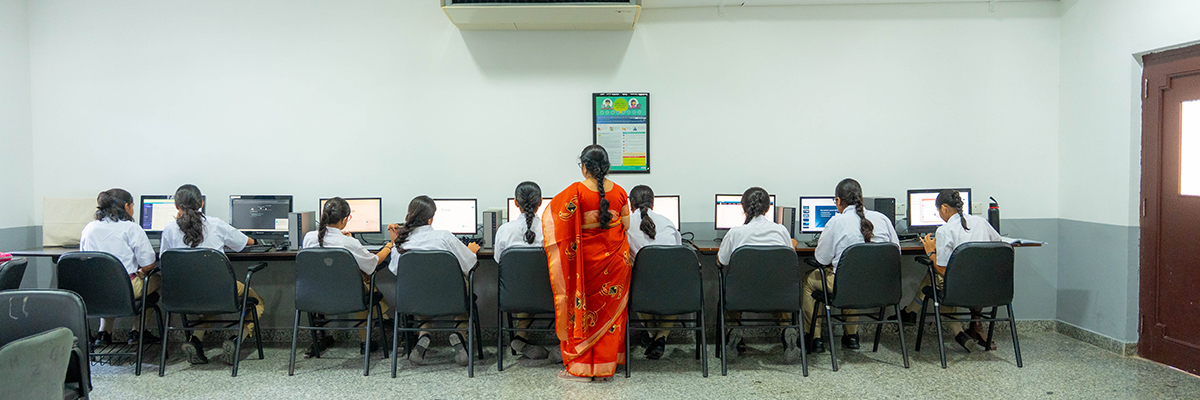
Practical facilities such as computer laboratories, robotics kits, coding resources and interactive learning spaces can further support this process. However, these resources are most effective when they are combined with structured teaching and opportunities for hands-on application.
It is also important to introduce concepts according to students’ age and understanding. Younger learners can begin with simple sequencing activities, basic coding exercises and introductory robotics projects. As they progress, they can explore more advanced programming, AI applications and independent project development.
The objective should be to make technology education accessible, engaging and relevant to students at different stages of their academic journey.
Conclusion
AI and robotics are gradually changing what school education can look like. They are creating opportunities for students to move beyond theoretical learning and actively participate in understanding and developing technology.
Through practical experimentation, coding, problem-solving and collaborative projects, students can develop skills that extend far beyond technical knowledge. They learn to think independently, approach challenges creatively and understand the importance of responsible innovation.
For girls, these opportunities are particularly meaningful. Access to technology-based education allows them to explore emerging fields, challenge conventional expectations and recognise their potential to contribute to future innovations.
At Heritage Girls School, Udaipur, this approach is reflected in initiatives such as its AI and Robotics Lab and the introduction of hands-on robotics learning. The school’s AI and Robotics Lab was inaugurated in April 2025, with students from Grades V to IX participating in an interactive session that introduced them to the technology and gave them an opportunity to operate a robot.
Such experiences demonstrate how schools can bring emerging technologies into everyday learning and encourage students to explore possibilities beyond traditional classroom lessons.
Ultimately, the purpose of introducing AI and robotics into education is not simply to prepare students to work with machines. It is to help them develop the curiosity, knowledge and confidence to shape the world in which those technologies will be used. Because the future of education belongs not just to those who understand technology, but to those who know how to use it thoughtfully, creatively and responsibly.